No. 33 Sunday 15 November Game dev, software and AI

Small scope, sharp checks

One developer's $8 co-op game passed 250,000 copies in nine months of work. Plus Google's recipe for checking agents with tools they cannot bend, a measured cost of too many MCP tools, and a backdoor that rides in on a model.

The short version

  • Game dev Crack, an $8 co-op game made by one developer in about nine months, passed an estimated 250,000 copies and $1.5 million gross, and GameDiscoverCo reads it as a sign of where small PC games are heading.
  • Software and AI Google's /teamwork pairs many agents with falsifiers they cannot edit: Lean proofs, unmodified test suites, simulators. Its Rust port of an AV1 decoder matched the C++ bit for bit and ran 20 to 30% faster.
  • Software and AI One developer measured a 52-tool MCP setup at 24,600 tokens of tool descriptions per turn against 640 for four focused tools, with right-first-time tool choice falling from 99% to 78%.
  • Software and AI Microsoft showed a poisoned open model can carry a trigger that makes coding agents run unsafe commands, in up to 97% of tries in one harness. The fix is to treat checkpoints like unsigned code.
  • Game dev On Steam, AI disclosure is common among games few people review (47%) and rare among the most reviewed (14%), a talk at MIGS showed.
Game dev Lesson

One developer, nine months, 250,000 copies

Crack, an $8 co-op incremental game where friends work together to break open a giant egg in a strange lab, was made by one developer in about nine months and has sold an estimated 250,000 copies.

ContextGameDiscoverCo is a newsletter and data service that tracks how players find and buy games on Steam.

A first-person view in a dim lab: a giant egg stands under spotlights, blob-like lab workers in goggles walk around it, and a big red button sits in the foreground.
Image: Rafoli, Crack on Steam

Crack peaked at 8,500 players at once on Steam and drew more than 1.2 million hours of viewing on Twitch in 30 days. GameDiscoverCo estimates more than $1.5 million in gross sales so far and thinks it could reach $4 to $5 million. It was a top 15 new release on Steam in October.

The creator, Rafoli, coded it by hand with no AI and no asset packs, with outside help only for music and marketing. The game ends when the egg cracks; median playtime is just under four hours, close to a full run, so most buyers seem to finish it.

GameDiscoverCo's argument is about demand: many players want $7 to $12 scenarios to play through with friends, not $40 to $60 games that ask for months. The risk is the same low barrier that made Crack possible: many solo developers can spend nine months on a game like this.

250k+copies sold, GameDiscoverCo estimate (over 250,000)

Technical details

GameDiscoverCo's Pro data: 58.6% of Crack players also played Peak, 6.8 times the rate of the average Steam player, and 28% of owners are in the US, followed by Germany, Russia, the UK, Canada, Turkey, France and China. All sales figures are estimates, not the developer's numbers.

Why it mattersIt is evidence that a small team can win on Steam with a short, finished co-op scenario at a low price, if the hook is clear and the play is fun to watch on stream.

For youThis supports small, social web and mobile titles: a single-mystery co-op scenario with an ending is a cheap thing to prototype on the existing gameplay plugins before committing to the larger action RPG schedule.

co-op
A game played together with other people on the same side, rather than against them.
incremental
A game style where you repeat simple actions to earn upgrades that make each action pay more.
gross
Total sales before the store's cut, refunds and taxes.

Sources GameDiscoverCo: Is Crack the future of small-footprint PC game success?Crack on Steam
More like this Less like this

Small games: getting found, feeling new

A playbook for China, what AI disclosure signals on Steam, and a gravity trick.

Game dev Do this

How to be found by Chinese players on Steam

China is Steam's second-biggest market by lifetime revenue, and a China consultancy's playbook says a few channels done well beat a presence everywhere.

GameDiscoverCo estimates lifetime Steam revenue at $25.8 billion from the US and $14.9 billion from China. The playbook from Hidden Player, condensed:

  1. Localize the store page fully

    Translate the game's title into Simplified Chinese so it can be searched, and redo the capsule and every image, roadmaps included.

  2. Keep talking after launch

    Translate Steam news posts on time and answer posts in the Chinese forums. Few Western studios do, so even a little stands out.

  3. Add Heybox

    This unofficial Steam companion app has developer accounts, posts, messages and a wishlist sync back to Steam.

  4. Pick one video home

    Bilibili, with 370 million monthly users, rewards a Chinese-speaking community manager. Huqiao Games adds: check local demand before spending.

Why it mattersChinese players buy on the same Steam store as everyone else, so localizing the page and showing up in their communities reaches a market as big as many countries combined.

For youFab buyers and Steam players in China both search in Simplified Chinese; a localized title and capsule is a cheap test on the next game page.

capsule
The main artwork that represents a game in Steam's store lists and search results.
Heybox
A popular Chinese mobile app that works as an unofficial companion to Steam, with news, reviews and community posts.

Sources GameDiscoverCo: What's your China playbook?PocketGamer.biz: PGC Montreal and MIGS takeaways

More like this Less like this

Game dev Trend

AI-disclosed games crowd the release list, not the reviews

Games that tell Steam they used AI make up a large share of new releases but a small share of what players review, according to figures shown at a Montreal conference.

Figures from indie consultant Adam Clare's talk at MIGS, as reported by PocketGamer.biz.

Reviews stand in for sales here; the talk did not say how the figures were collected. A separate panel reported senior artists reaching a final asset faster than juniors, with fewer prompts.

Why it mattersIf players mostly ignore games that lean on AI, the time saved in production may not turn into sales; it is a reason to treat AI as a tool behind taste, not a substitute for it.

For youWorth weighing before ticking the AI disclosure box for generated store art or trailers; keep AI in tooling and code, where players do not see it.

disclose AI
Steam asks developers to state on the store page whether generative AI was used to make the game.

Sources PocketGamer.biz: PGC Montreal and MIGS takeaways

More like this Less like this

Game dev Lesson

Walls become floors: radial gravity in a Godot shooter

A developer built a shooter inside a hollow sphere where gravity pulls outward, so every wall is a floor, and explained how each player turns to stay upright.

Balitti, a manga-style shooter by the developer sembask, runs inside a hollow ball. The world never turns; each player does.

How the gravity works, as the developer described it to 80 Level. Because the correction is a small change on top of the current rotation, the player keeps facing where they were looking.

Why it mattersRotating each player instead of the world is a pattern that works for any custom-gravity controller, in any engine, and it keeps co-op simple because every player handles their own up.

For youThe same delta-rotation trick maps to a UE5 character with a custom gravity direction; a small world-tools experiment for a planetoid or wall-run level.

Area3D
A Godot node that marks a region of space and can override gravity for anything inside it.
yaw
Turning left or right around the vertical axis; pitch is looking up or down.
physics frame
One fixed step of the game's physics update, usually many times a second.

Sources 80 Level: radial gravity turns walls into floors

More like this Less like this

Checks the agent cannot argue with

Outside judges, a pledge against slop, and lean tool lists.

Software and AI Lesson

Many agents, one judge they cannot bend

ContextAntigravity is Google's agent coding app; /teamwork is its mode for running many agents on one job.

Google described how its multi-agent mode gets long, hard jobs right: agents explore in parallel, and only answers that pass a strict outside check, such as a proof checker or untouched tests, survive.

Google Research's write-up of the patterns behind /teamwork, with results it reports itself. The key part is the falsifier.

Google reports a Rust rewrite of its AV1 video decoder, about 170,000 lines, matching the C++ bit for bit on a conformance suite; it started 4 times slower and ended 20 to 30% faster once agents could run profilers. A math formalization took 28,800 subagent runs.

Why it mattersThe lesson travels: give each agent less context, and let something it cannot edit decide what counts as done. More agents only help when the judge is outside them.

For youMatches the subagent setup: give reviewer subagents a clean context with no plan or reasoning from the implementer, and gate plugin changes on the unmodified automation tests.

falsifier
A check that can prove an answer wrong without trusting whoever produced it, such as a test suite or a proof checker.
Lean
A programming language and proof checker that verifies mathematical proofs line by line.
AV1
A modern open video format; a decoder turns its compressed data back into frames.

Sources Google Research: Advancing science and engineering with /teamwork

More like this Less like this

Software and AI Trend

A manifesto against AI slop

Speakers and attendees of an AI engineering summit wrote a short manifesto, modelled on the Agile one, about not passing unchecked AI output on to others.

Slop is when we put less effort into producing something than we ask the consumer to spend understanding it.

No AI Slop manifesto, speakers and attendees of AIE Code Summit 2026

It asks signers to say when an agent wrote something, to keep reviewing a subset of outputs scaled to the stakes, and to fix the system when a mistake shows up twice. The signatory list showed 352 names when read.

Why it mattersIt names the cost that review time carries when agents can produce more than people can read, and turns it into habits a team can adopt.

For youThe twice-seen-mistake rule maps directly to adding a hook or test whenever an agent repeats an error.

Sources No AI Slop: A ManifestoLatent Space: The No AI Slop Manifesto

More like this Less like this

Software and AI Lesson

Fifty-two tools cost more than tokens

A developer measured an agent with 52 connected tools against one with four focused ones: the big set filled the context with descriptions and made the agent pick the wrong tool more often.

Every connected MCP tool sends its description to the model on every turn. The author's own runs, with token counts estimated from character length:

52 tools 4 focused tools
Tool descriptions per turn 24,600 tokens 640 tokens
Over a 10-step loop 246,000 tokens 6,400 tokens
Right tool on the first try 78% 99%
Time to first token 3.4 seconds 1.1 seconds

The author found wrong tool picks hurt more than the raw token cost. Their fixes: turn servers on per project, keep 15 to 20 tools at most, and replace chatty servers with small scripts that print only the fields needed.

Technical details

The estimate divides each tool's JSON description length by 3.6 characters per token rather than using a real tokenizer, and the 10-step figure adds up every turn's input, so it counts the same descriptions again each step. Prompt caching cuts the price of repeated descriptions but not their room in the context or their effect on tool choice.

Why it mattersTool lists are easy to grow and rarely pruned. Fewer, sharper tools leave room for the work and make the agent's choices more reliable.

For youRun /context in a session with every MCP server on, then switch the Unreal and Supabase servers to project scope only; the measured drop is today's Try this.

MCP
Model Context Protocol, a standard way to plug tools and data sources into an AI agent.
context
Everything the model reads on a turn: instructions, tool descriptions, files and conversation so far.
time to first token
How long the model takes to start answering after a request is sent.

Sources DEV: Your MCP servers are silently draining your context window

More like this Less like this

Models, doors and dials

Poisoned checkpoints, automated probing, a cheap judge and small releases.

Software and AI News

A backdoor that rides in on the model

Microsoft researchers trained small open models to run an unsafe command when they see a hidden trigger, and the trick worked across popular coding agent apps, including ones the model never saw in training.

Attack success when a poisoned Qwen3.5 model (4B or 9B parameters) ran inside each agent app, on repositories it had not seen.

Microsoft says this is not a flaw in the apps' default setups: the risk exists only when an app runs a backdoored checkpoint. Removing the reasoning traces from the poisoned examples dropped success to about 1% or less.

Technical details

In a second study, about 1% poisoned examples in a fine-tuning set made gpt-4.1-mini take the unsafe action in 78.0% and 77.8% of 500 trials on the two harnesses seen in training, 11.0% on one unseen harness and 0% on another. Microsoft's advice: pin datasets by hash, test third-party checkpoints in the real harness, scope credentials, sandbox, and watch for tool calls that do not follow from the request.

Why it mattersIf you run downloaded open models in an agent, the model file is code you did not write: sandboxing and narrow permissions are what stop a hidden trigger from doing damage.

For youRelevant to any experiment with local open models behind Claude Code-style harnesses: run them in a sandbox with no production Supabase keys.

checkpoint
A saved copy of a model's trained weights that others can download and run.
harness
The app around a model that gives it tools, runs its commands and shows the results, such as Claude Code.
fine-tuning
Extra training on a smaller dataset to change how an existing model behaves.

Sources Microsoft Security: Trained to betray

More like this Less like this

Software and AI Trend

AI attack tools now probe sites around the clock

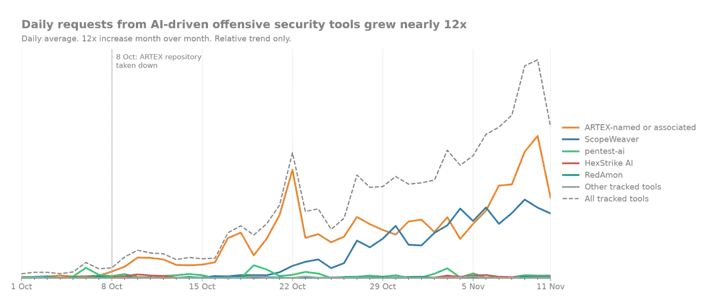
Cloudflare says open-source AI hacking tools that chain many scanners together have spread fast since one leaked in October, while a separate study found thousands of AI-built sites handing out database records to anyone.

Line chart of daily requests from AI-driven offensive security tools, October 1 to November 11, rising steeply after the ARTEX repository was taken down on October 8.
Image: Cloudflare

30xgrowth in daily requests from AI pentest tools since October 1, per Cloudflare

24,664Lovable sites, of 34,545 on Supabase, that sent database records on load without login

ARTEX, a tool that chains attack tools through MCP with parallel agents, and its forks now make up over 60% of the AI pentest orchestrators Cloudflare knows. Crissy Field's researchers say sending records on load is not a breach by itself, but they found passport details and over 200,000 private messages exposed.

Why it mattersSmall apps are no longer too small to be scanned. Check that your database refuses anonymous reads, because automated tools will try.

For youEvery SaaS on Supabase should be checked logged out with the anon key, table by table, after each schema change.

pentest
Penetration test: probing a system for security holes the way an attacker would.
orchestrator
Software that runs many tools or agents in order and passes results between them.

Sources Cloudflare: Adapting to AI penetration testing orchestratorsCrissy Field: Lovable apps expose data

More like this Less like this

Software and AI Release

Perplexity Decider v1.3

An open-weight classifier and judge that returns a probability for each option, and can now point to spans in the text.

Perplexity released an open model that reads a text and picks among answers you give it, in one quick pass, which suits routing requests and grading other models' work.

Perplexity says v1.3 averaged 91.6% on 63 classification tasks, 6.54 points above its own production classifiers, and agreed with large-model judges 93.98% of the time on real requests. Its answers flipped on 0.27% of questions when labels were reworded. All numbers are the vendor's.

Licence
Apache, on Hugging Face and OpenRouter
Sizes
Built on Qwen3.8-27B, with a Flash version distilled to 4B
New
locate: marks names, personal data or answers in the text

Why it mattersA cheap, local judge makes it practical to grade every agent output or route easy requests to small models, instead of paying a frontier model for each check.

For youA candidate for routing support or moderation in the SaaS products, and for a cheap pass or fail check in agent eval loops.

open-weight
A model whose trained weights are published, so anyone can download and run it.
distilled
A smaller model trained to copy a larger one's answers, so it runs cheaper.

Sources Perplexity: Decider v1.3

More like this Less like this

Software and AI Release

What shipped: capped tokens, Node 27, Codex trust

Small releases from the week's end: a capped monthly token plan, a second preview of Node.js 27, and a Codex change that matters for scripts.

From the changelogs, November 12 and 13.

  • Vercel Token Pass

    Now $150 of open-model tokens for $30 per team per month. Pass-scoped keys stop when the credit runs out, with no overage.

  • Vercel Sandbox npm credentials

    Sandboxes can install private packages with team credentials while the token stays outside the sandbox.

  • Node.js 27 alpha

    Identical concurrent dns.lookup() calls now share one request; a timedOut flag lands in child_process. Not for production.

  • Codex 0.169

    codex exec and codex review keep project config and MCP servers off in untrusted folders; --trust saves trust for that folder.

Why it mattersHard caps and trust prompts are how teams keep unattended agents from overspending or loading tools nobody approved.

For youA capped key is a sensible budget for background automations that call open models; check any CI script that runs codex exec in a fresh checkout.

overage
Usage billed beyond a plan's included amount.

Sources Vercel changelogNode.js 27.0.0-alpha.0.1.0Codex releases

More like this Less like this

Learn one thing

What is an incremental game?

A game where you repeat a simple action to earn something, spend it on upgrades that make each action earn more, and watch the numbers grow, often while the game plays itself.

Think of it like thisIt is like a lemonade stand where every sale buys a better juicer, until the stand runs a factory without you.

The genre began in the early 2000s with joke games like Progress Quest and grew with Cookie Clicker. Games that ask you to click are often called clickers; games that keep earning while you are away are called idle games. Many mix both, and many add prestige: reset your progress on purpose for a permanent bonus.

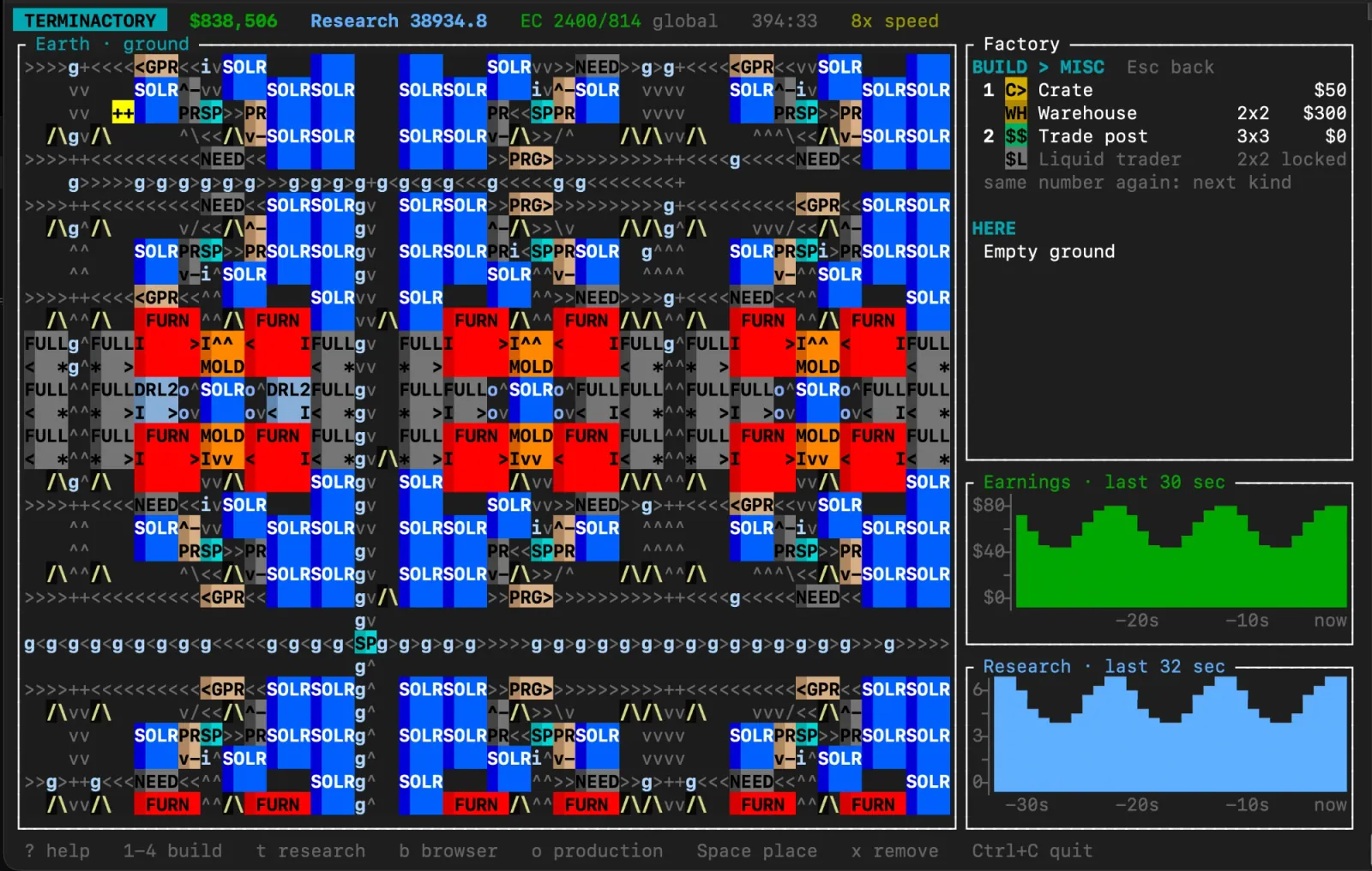
The loop is cheap to build and easy to understand, which is why it now turns up inside other genres. Today's lead wraps it in a co-op mystery with an ending, and a terminal factory game in Sparks uses it as something to do while an agent works.

The core incremental loop. Each turn of it makes the next one faster, so numbers grow steeply; prestige resets add a slower outer loop.
prestige
Choosing to reset your progress in exchange for a permanent bonus that makes the next run faster.

Try this today

Software and AI 30 minutes For practitioners

Weigh your agent's tool list, then cut it

Find out how much of every turn your connected MCP tools take up, and get it down without losing anything you use.

You needClaude Code or another agent with MCP servers connected.

  1. Measure

    Start a fresh session in a real project and run /context to see how many tokens the MCP tools take before you type anything. Then run /mcp and note each server and its tool count.

  2. Scope them

    Move servers you only need in one project out of your user-wide settings and into that project's config.

  3. Swap one for a script

    Replace one chatty server with a short script around its CLI that prints only the fields you need, as the article does with gh pr view --json.

  4. Measure again

    Open a fresh session, run /context again and compare. Run one ordinary task and watch for wrong tool picks.

gh pr view 123 --json title,state,files

You know it worked whenThe MCP tools line in /context is smaller, and the agent still finds every tool the project needs.

For youStart with the global servers in the Claude Code setup: the Unreal and Supabase servers only belong in their own repositories.

MCP server
A small program that offers an agent a set of tools, such as reading a database or a GitHub repository.

Sparks

What is catching on right now, and the idea worth borrowing from each.

The lab

Research from the front line, in plain words: what it solves, how, and what you could do with it.

Software and AI PreprintarXiv preprint (cs.SE)

Tests for exactly what a pull request changed, kept only if they fail before and pass after

ADAPT: Agentic Diff-Aware Patch Testing for Pull RequestsVahid Haratian, Atakan Akar, Eray Tüzün, et al. (Bilkent University)

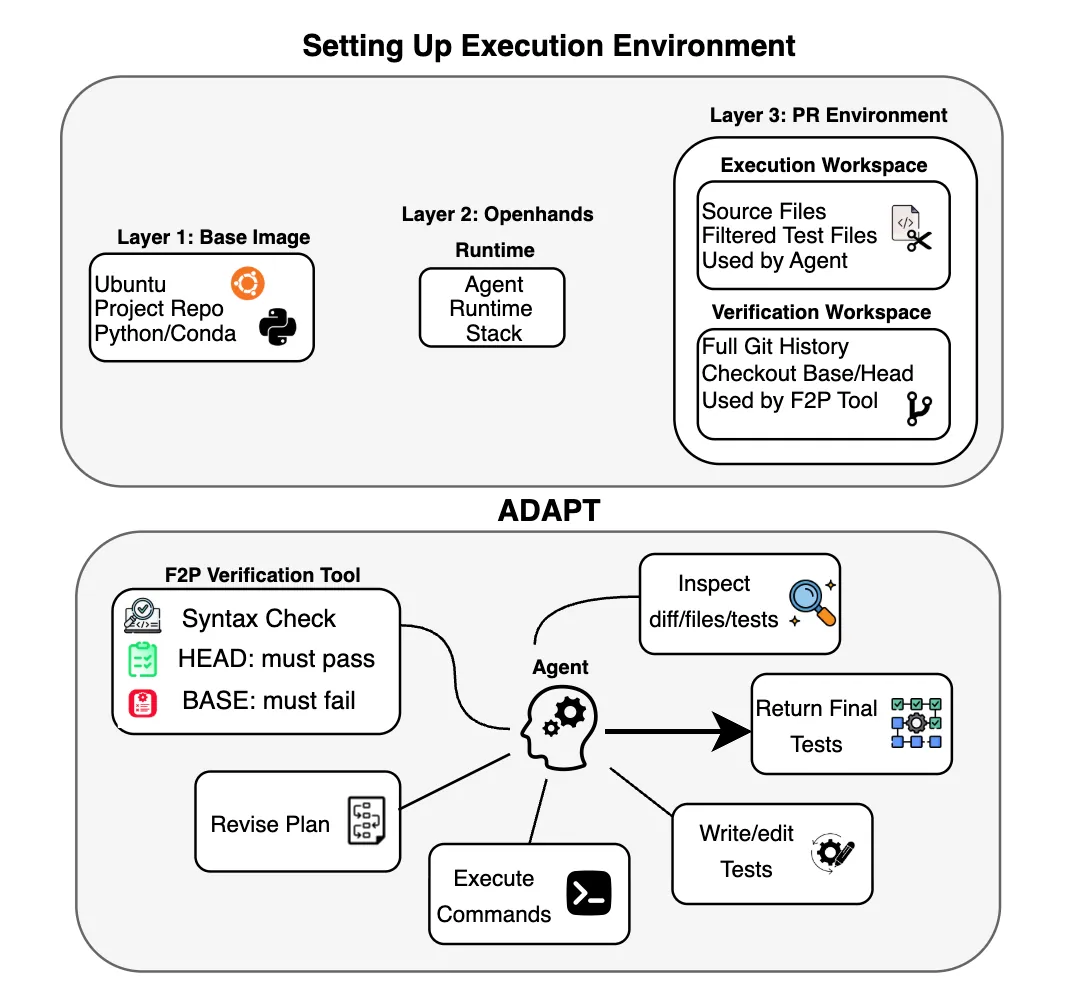
Diagram of ADAPT: an execution environment in three layers above an agent that inspects the diff, writes tests, runs commands and calls a verification tool requiring HEAD to pass and BASE to fail.
Image: Haratian et al., arXiv (CC BY 4.0)
The problem
Many merged pull requests arrive without tests, and test generators chase coverage of whole files instead of the behaviour the change introduced.
The idea
An agent built on OpenHands reads the diff from base to head, writes candidate tests, and runs them through a checker that keeps only tests that fail on the old code and pass on the new. The checker also reports which changed lines are still uncovered, and the agent tries again.
The result
On 426 SWE-bench Verified pull requests, 62.0% got a fail-then-pass test with GPT-4o, against 35.4% reported for the earlier tool BLAST; with GPT-5 mini it reached 89.9%, at $16.62 for all 426. On 137 pandas, SciPy and Qiskit pull requests it fully covered 83.9% of changes against 79.6% for ChaCo, in about a third of the time.
Use it
Add a fail-then-pass gate to agent pull requests: tests written from the diff only count if they fail with the change stashed and pass with it applied.

For youWorks as a review subagent step for SaaS pull requests; for plugins, the same gate fits UE automation tests run on base and head builds.

More like this Less like this

  1. Idea
  2. Prototype
  3. Code released
  4. Shipping

ReadarXiv: 2611.16114Replication package

Software and AI PaperACM Transactions on Software Engineering and Methodology

Developers really do install packages an AI made up

Package Hallucinations as Phantoms in Open Source Software Supply Chains: An Empirical Security AnalysisZhe Huang, Chaoge Liu, Zhi Wang, et al. (Beijing Institute of Technology, Zhongguancun Laboratory)

The problem
Language models sometimes recommend packages that do not exist. Whether attackers can profit by registering those names had not been measured in the wild.
The idea
Collect 107 package names that eight models invented, register them on npm, and watch who installs them for six months. Then build NymGuard, an agent that spots invented names, registers them first and keeps a public warning list.
The result
35.2% of installs came from developers, most first installs arrived within two weeks of registration, and 25.2% of the invented names were one character away from a real package. Adding web search raised how often the same fake name came back, from 11.2% to 17.3%. The authors estimate the attack costs about $496.
Use it
Before an agent adds a dependency, check that the package exists, is not brand new and has real downloads; block installs of names one edit away from a popular package.

For youA pre-install hook that checks npm age and downloads would cover the Node and React projects where agents add packages unasked.

More like this Less like this

  1. Idea
  2. Prototype
  3. Code released
  4. Shipping

ReadACM: 10.1145/3830237Code

Software and AI PreprintarXiv preprint (cs.SE), field study

Agents chasing database bugs failed for lack of a view, not a brain

Where LLM Agents Get Stuck Debugging Databases: Access More Than ReasoningGustavo Pinto (Federal University of Pará)

The problem
When an agent fumbles a production incident, teams cannot tell whether it reasoned badly or simply could not see what was happening.
The idea
Study a team's real use of Claude Code on eight database incidents in a production messaging system over ten days, cross-checking session transcripts, git history and deploy records.
The result
Across 27 sessions, about 3,000 tool calls and 22 fix commits, all five incidents that depended on concurrency started with a false start, and a gap in access to runtime state was present in every one; in four it combined with a reasoning error. The three other incidents needed nothing extra. Most calls went to DeepSeek models through the Claude Code harness.
Use it
Give a debugging agent read-only access to live database state, such as lock and activity views and full deadlock logs, and have it write down each hypothesis and the evidence that killed it.

For youA read-only Postgres view tool (pg_locks, pg_stat_activity) for the Supabase projects would close exactly the gap this study found.

More like this Less like this

  1. Idea
  2. Prototype
  3. Code released
  4. Shipping

ReadarXiv: 2611.17304

Also moving

This week on Toa Radar

Read the weekly summary: The week the checks moved outside the agent
Tune mode is on in this browser. Turn it off