No. 29 Wednesday 11 November Game dev, software and AI

Unreal opens its editor to agents

Epic's Unreal Engine 5.9 preview was mostly written by agents, and it lets your own agent drive the editor. Plus why stale TODO comments cost agents time, one sentence that changes how Fable 5.2 edits code, and a 44 times cheaper classifier.

The short version

  • Game dev Unreal Engine 5.9's preview adds Unreal Assistant, a panel that runs Claude Code, Codex, Cursor or OpenCode inside the editor over Unreal MCP. Epic says agents wrote most of the release in about a week.
  • Game dev Unreal can target the browser again through WebAssembly and WebGPU, but it is experimental: source builds only, crashes past 2 GB of memory, and no joining servers yet.
  • Software and AI Google found that when coding agents chase old TODO bug comments unasked, the session takes 70% more steps and 105% more wait time.
  • Software and AI Anthropic's docs say telling Fable 5.2 the codebase is its own makes it merge repeated code in about half of tries, against under a tenth without.
  • Software and AI Amazon swapped Sonnet 4.6 for a small classifier on a ticket labelling job: 4.2 seconds down to 0.9, and about 44 times cheaper per ticket (vendor figures).
Game dev Release

Built by agents, open to agents

Epic released an early preview of Unreal Engine 5.9 that it says was mostly written by AI agents, and it lets developers plug their own coding agent straight into the editor.

ContextUnreal Engine is Epic Games' 3D engine; Epic said last week that 5.9 would preview with the web as a target, ahead of its AI MegaJam on November 12 to 15.

How a coding agent reaches the editor in the 5.9 preview, per Epic's release post.

Epic calls the 5.9 MegaJam Preview the first Unreal release built mainly with agent workflows: a handful of people directed fleets of agents that ported AI tools and wrote the new web platform, while engineers reviewed and tested. It had about a week of development and a shorter test pass than usual.

The part developers can use is Unreal Assistant, an experimental editor panel where you work with Claude Code, Codex, Cursor or OpenCode. It talks to Unreal MCP, which now starts with the editor and offers tools for rendering, source control, profiling, debugging, gameplay testing, geometry, audio, UI and level building. A new Fab toolset lets an agent search the store, browse your library and install assets.

Epic recommends testing on a copy of a project rather than converting one, and lists a catch: in new projects the toolset plugins are off, so an agent connects but gets no editor tools until you enable them.

Technical details

Known issue UE-412135: new projects ship with the AllToolsets, EditorToolset, BlueprintToolsets, ConsoleToolset and LiveCodingToolset plugins disabled, so list_toolsets returns no actor, level, asset, Blueprint or Python tools. Enable All Toolsets in Edit > Plugins (or add AllToolsets to the .uproject), restart and reconnect.

Other items in the preview notes: a Modular Test Framework for scoped plugin tests, GraphDsl (a text language for graph assets), StateTree tasks editable from Blueprint or Python, Python APIs for audio, MetaSounds, modeling, physics, Niagara, materials, PCG and UI, a runtime path-traced Lumen World Cache that needs hardware ray tracing, and Unreal Canvas, a shared space where people and agents make content with generative services.

Epic says it is still cleaning up agent-written code and that parts of the web renderer are prototypes to be refactored before the full 5.9 release. Known crash UE-411502: swapping a Blueprint's root through Python can crash the editor.

Why it mattersAgents that can open levels, edit Blueprints and run a profiler can test and fix gameplay, not only write code. Plugin makers should expect buyers to ask whether their tools work from an agent.

For youInstall the preview beside 5.8, copy one plugin's demo project, enable All Toolsets, and see whether an agent can find and configure the plugin's components; that tells you what to document for agent users before Fab buyers ask.

MCP
Model Context Protocol: a standard way for an AI agent to discover and call tools that another program offers.
toolset
A group of related actions the editor exposes to agents, such as editing Blueprints or running a profiler.
Blueprints
Unreal's visual scripting system, where game logic is built by wiring nodes together.
Fab
Epic's marketplace for game assets, tools and plugins.

Sources Epic forums: Unreal Engine 5.9 MegaJam PreviewEpic: Unreal Engine 5.9 release notes80 Level: 5.9 Preview is out and was built with AI
More like this Less like this

Engines and tools this week

Unreal on the web, scans in Blender, and a faster Defold.

Game dev Release

Unreal in the browser is back, with a list of limits

For the first time since Unreal 4 dropped its web export, Unreal games can run in a browser again through WebAssembly and WebGPU, but the preview comes with hard limits worth knowing before you plan a web release.

From the known issues Epic published with the preview:

  • What it needs

    A source build of the engine and a C++ project. It uses the mobile renderer, and Chrome works best.

  • Memory and size

    Games crash above 2 GB of WebAssembly memory. itch.io caps browser games at 500 MB total and 200 MB per file, which Lyra and development builds exceed.

  • Textures and video

    BC and DXT textures fail on Android and on iPhones older than the 15 Pro, so cook with ASTC. Bink video does not play.

  • Saves and servers

    Web-ready projects cannot join servers yet, and in some builds saves and settings vanish on reload.

Technical details

Issue numbers: UE-411671 (crash above 2 GB Wasm memory), UE-412027 (no IpNetDriver in --web-ready projects), UE-412003 (saves lost on reload in launcher-built C++ web games), UE-411672 (Bink unsupported), UE-412148 (iOS 26 WebKit uses far more thread memory than iOS 27), UE-411308 and UE-411939 (opening index.html from file:// fails). Mac and Linux premade builds were missing some Wasm support files at launch.

Why it mattersA browser build is the shortest path from a game to a player, for demos, jams and playtests. These limits decide whether that path is open to your project yet.

For youWorth one test build of a small three.js-sized scene to compare download size and load time against the existing web stack; do not plan a web release on it yet.

WebAssembly
A compact code format browsers run at near native speed, used to bring C++ programs to the web.
WebGPU
The modern browser interface for drawing graphics and running work on the graphics card.
ASTC
A texture compression format that works on nearly all phones.
source build
An engine compiled yourself from Epic's code, instead of the ready-made launcher version.

Sources Epic forums: 5.9 MegaJam Preview known issuesGameFromScratch: Unreal Engine 5.9 Preview

More like this Less like this

Game dev Release

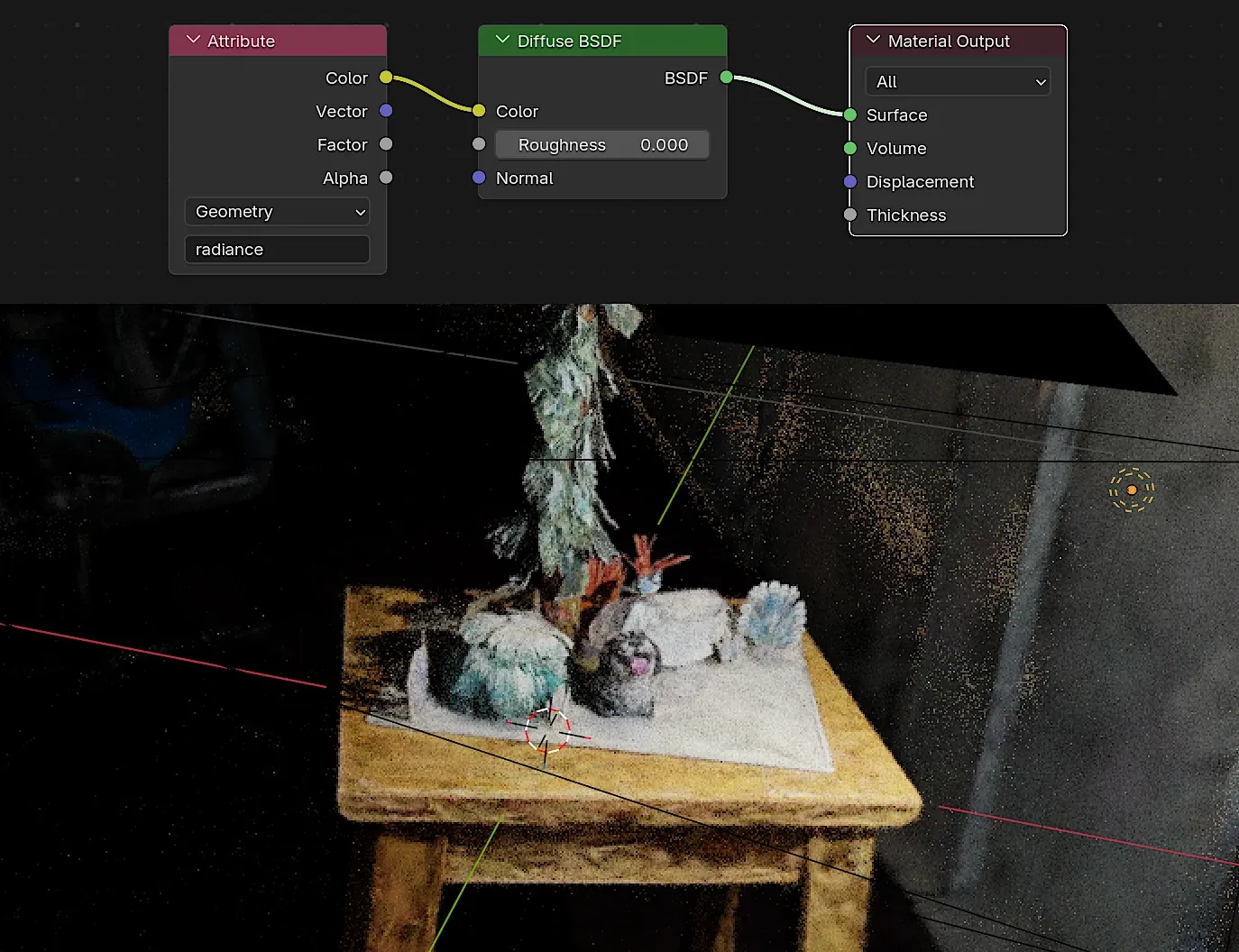
Blender 5.3 treats Gaussian splats as real geometry

Blender can now import 3D scans made of Gaussian splats, edit them with its node tools and render them, which makes captured scenes easier to clean up and reuse.

A Blender node graph feeding a splat's radiance attribute into a Diffuse BSDF, above a viewport showing a scanned table with small objects rendered as a splat cloud.
Image: Blender Foundation

Blender 5.3 imports splats from PLY, SPZ and glTF files, lets Geometry Nodes crop and transform them, and renders them in EEVEE, Cycles and Workbench. They show as glowing by default; relighting them is still basic, and performance is still being tuned.

The release also makes Vulkan the default in EEVEE and the viewport, and lets studios share asset libraries as installable extensions.

Technical details

Splat attributes: scale (vector), rotation (quaternion), radiance:base (base color with opacity in the fourth component) and radiance:sh_{index} for spherical harmonic bands. Blender notes color can drift because splat tools work in sRGB and Blender in linear space. Cycles also gains DLSS 4.5 Ray Reconstruction as a denoiser (NVIDIA driver 620 or newer).

Why it mattersScans are a cheap way to get real places into a game, but they have been hard to edit. A standard tool that can crop and transform them shortens that path.

For youTry one phone-captured prop through Blender 5.3 to see if a cleaned splat can serve as a reference or backdrop for environment work.

Gaussian splat
A way to store a captured 3D scene as many small, soft, colored blobs instead of triangles.
Geometry Nodes
Blender's node system for building and changing geometry with rules instead of by hand.
point clouds
Geometry made only of points in space, with no surfaces connecting them.

Sources Blender 5.3 release notes

More like this Less like this

Game dev Release

Defold 1.14.1

A free, lightweight 2D and 3D engine aimed at web and mobile games.

The free Defold engine, popular for small web and mobile games, now draws text sharply at any size, debugs Lua scripts with standard tools, and reports big speedups for particles.

New fonts default to vector rendering, so text stays sharp at any size. Lua scripts can now be debugged over the standard Debug Adapter Protocol, so editors that speak it can set breakpoints and step through code.

Debug and headless builds also describe their runtime services in OpenAPI, a machine-readable format that scripts and agents can read.

Particles
About 94% faster vertex work in a 200,000-particle test
Transforms
1.17 to 3.25 times faster in 100,000-object tests
Windows
OpenGL, Vulkan or DirectX 12, chosen per project
Breaking
WebGL 1 and OpenGL ES 2.0 shaders now off by default

Try ithttps://defold.com/2026/11/10/Defold-1-14-1

Why it mattersSmall engines compete on build size and iteration speed; a standard debugger and machine-readable runtime make Defold easier to automate and test.

For youThe OpenAPI runtime description is a pattern worth copying in your own game servers so agents can query live state.

Debug Adapter Protocol
A standard that lets any code editor control a debugger the same way.
headless
Running without a window or screen, for servers and automated tests.
OpenAPI
A standard file format that describes what a web service offers, so tools can call it without guessing.

Sources Defold: release 1.14.1

More like this Less like this

Code that agents read well

What dead comments cost, one prompt line, and newer web habits.

Software and AI Lesson

Old TODO comments send coding agents on detours

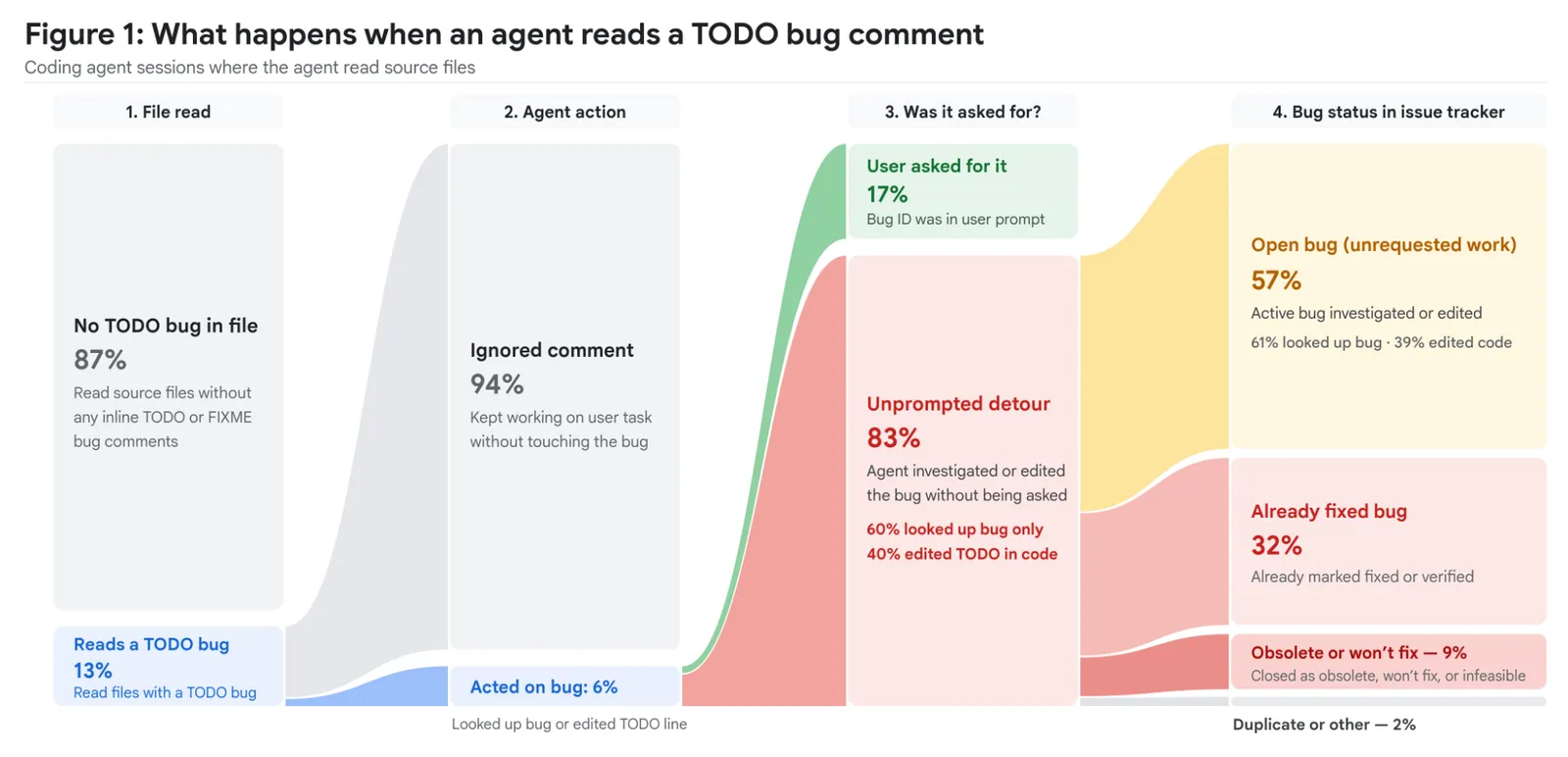
Google measured what happens when coding agents read old TODO notes that point to bug tickets: mostly nothing, but when an agent wanders off to chase one unasked, the session gets much longer and costlier.

Flow chart: 13% of file reads include a TODO bug; agents ignore 94% and act on 6%; 83% of actions are unprompted; of those, 57% target open bugs, 32% already fixed bugs and 9% obsolete or won't-fix tickets.
Image: Google Developers Blog

Google engineers Sam Saccone and Madhuri Garikapati studied agent sessions across thousands of Google engineers. In 13% of sessions the agent read a TODO or FIXME that named a bug. It ignored the note 94% of the time; in the 6% where it acted, 83% of those actions were unprompted. Of those detours, 41% chased tickets that were already closed, and 57% went after open bugs nobody had asked about.

Compared with similar sessions from the same developer, an unprompted detour meant 70% more steps, 77% more tokens and 105% more wait time (Google's figures). Google's answer was cleanup agents: over six months they removed thousands of obsolete TODOs after checking bug and file history, and reviewers accepted over 95% of the changes.

Technical details

The overhead figures come from a fixed-effects regression that held developer, codebase area, task type, files read, prompt length, timing and model constant; ranges were +54 to +87% for steps, +60 to +96% for tokens and +86 to +126% for wait time. Of open-bug detours, 61% only looked the bug up and 39% edited code. The post was published November 6 and covered by InfoQ on November 10.

Why it mattersCode hygiene used to be a nice-to-have for people. With agents reading every comment, dead notes now cost measurable time and money on every task that touches them.

For youPlugin source trees with years of engine-upgrade TODOs are a prime target; let an agent list TODOs whose referenced issue is closed and remove them in one reviewed pass.

TODO
A comment a programmer leaves in code to mark work still to do, often with a bug ticket number.
tokens
The small chunks of text a model reads and writes; providers bill by the token.

Sources Google Developers Blog: Agent distractionInfoQ: technical debt can derail coding agents

More like this Less like this

Software and AI Lesson

Tell Fable 5.2 the code is its own

Anthropic's prompting guide says one sentence telling Claude Fable 5.2 that it owns the codebase makes it clean up repeated code instead of piling on more.

~50%tries merged repeated code with the sentence

<10%tries without it

1.5xoutput tokens with it

Without it, the model tends to add to the existing structure and only report nearby problems. With it, it also makes unrequested changes, so review the whole diff. Small tests, Anthropic's own figures.

Why it mattersWho the prompt says owns the code now changes how much the model refactors, so it is a setting to choose, not a phrase to copy everywhere.

For youUse it in your own repos' instruction files, and leave it out of client work where the diff must stay small.

Sources Claude docs: Prompting Claude Fable 5.2Simon Willison: quoting the guide

More like this Less like this

Games and software Release

Browser makers ship a skill to update agents' web habits

Coding agents still write web code the way it was done years ago. The Chrome, Edge, Firefox and MDN teams published a free guide agents can load to use modern browser features instead.

Modern Web Guidance covers 250 web features and 203 common tasks. From the repo's own instructions:

# add the guidance to your coding agent
npx modern-web-guidance@latest install

# find the modern way to do a task
npx modern-web-guidance@latest search "animate a dialog modal backdrop"

# list old patterns in a project
npx modern-web-guidance@latest legacy-scan .

The install step adds plugins for Claude, Codex, Cursor, Gemini, Grok and Kimi. The maintainers say they used evals to cut content models already know, but the repo shows no results yet.

legacy-scan is the quickest test: it points at code a browser feature now handles, such as hand-built modals that a native dialog element replaces.

Why it mattersLess code to ship and maintain: native browser features replace scripts and libraries that agents keep reaching for out of habit.

For youRun legacy-scan on the browser game front end and one React SaaS app; pick the two biggest hits as agent tasks.

skill
A packaged set of instructions and references a coding agent loads when a task needs it.
MDN
Mozilla's web documentation site, the standard reference for HTML, CSS and JavaScript.
evals
Repeatable tests that measure how well a model or prompt does a task.

Sources GitHub: GoogleChrome/modern-web-guidance

More like this Less like this

Agents in production

The right size of model, surviving long waits, and safer test builds.

Software and AI Lesson

Amazon replaced a frontier model with a small classifier

For a job that only picks one label out of twenty, Amazon engineers swapped Claude Sonnet 4.6 for a small model that scores the options directly, and cut latency and cost sharply.

An internal ticket labelling job with 20 categories, per the Strands team's write-up. All figures are Amazon's own; no accuracy numbers were published beyond saying the small model did as well.

Claude Sonnet 4.6 Strands Decider E4B
Average time per call 4,215 ms 897 ms
Tokens per ticket 6,724 2,010
Output tokens per ticket 170 1
Cost per million tickets about $22,200 about $500

When the answer is one item from a fixed list, a model that scores the options beats one that writes text. The rollout is the part to copy: a switch ran both models side by side on live traffic, and rolling back took a 45-second config change.

Technical details

Strands Decider E4B is a Gemma 4 build that returns a probability per option plus a confidence score. It runs on a SageMaker ml.g5.xlarge (one A10G GPU, about $1.41 an hour), handling about 5,600 tickets an hour per instance. Labels were rewritten as one- or two-sentence criteria to fit a 4,096-token window. An AppConfig switch had three modes: BEDROCK (Sonnet only), DUAL (both, compared) and DECIDER. Reordering JSON keys shifted probabilities by up to 0.19, so requests are now sent with sorted keys.

Why it mattersMany production AI calls are routing and labelling, not writing. Measuring them against a small scoring model can cut both the bill and the wait.

For youAny SaaS feature that tags or routes user input is a candidate; run the small model in shadow beside the current one before switching.

classifier
A model that picks a category from a fixed list instead of writing free text.
Gemma
Google's family of open-weight models that anyone can run on their own hardware.

Sources Strands Agents: Amazon replaces Sonnet 4.6 with Strands Decider

More like this Less like this

Software and AI Lesson

Agents that wait for weeks need a journal

An agent that waits days for a supplier or a manager must survive crashes and restarts. A new article shows how durable execution lets it pick up exactly where it stopped.

Kiran Prakash of Thoughtworks, on martinfowler.com, builds a stock reordering agent that waits up to 7 days for replies and runs on Temporal and Cloudflare Workflows.

Measured wake times: about 14 ms on Temporal and 0.1 s on Cloudflare in memory; about 2 s rebuilt from the log on Cloudflare.
Technical details

The article pairs the journal with idempotency keys (the purchase order number) so retries do not duplicate orders, a cancel tool for compensation, approvals that expire and a price range rather than one price, and a rules version so old runs finish under old rules. Retry policy in the example: 6 attempts, 2 s first interval, backoff 2. It stresses the limits: the log records what the agent saw, not what happened, and prompt injection is still the harness's job.

Why it mattersLong-running agents fail in boring ways: restarts, deploys, timeouts. Logging every outside call turns those into pauses instead of duplicate orders or lost work.

For youAny routine that waits on a person or another service could move onto Cloudflare Workflows with step.do and step.waitForEvent rather than a polling loop.

durable execution
A runtime that logs each step's result so a program can restart after a crash without redoing finished work.
idempotency key
A unique id sent with a request so that repeating it does not do the work twice.

Sources martinfowler.com: Long-horizon agents and durable execution

More like this Less like this

Software and AI Release

One command gives each app build its own Supabase

Expo's build tool can now create a Supabase backend and wire its keys into every app environment, so test builds stop touching real user data.

From Supabase's announcement, for Expo projects with eas-cli 21.8.0 or newer:

  1. Connect

    Run eas integrations:supabase:connect. It creates a Supabase project, installs the SDK and writes keys to Production, Preview and Development.

  2. Split preview

    Add --environment preview to give preview builds and over-the-air updates their own project and keys.

  3. Develop locally

    Point Development at a local Supabase stack on your machine.

  4. Read the advisors

    Security and performance findings, such as a table with Row Level Security off, show in the Expo build dashboard.

Technical details

Every command in the integration runs without prompts and returns JSON, which Supabase says lets an agent set up a backend in the same pass as the app.

Why it mattersSeparate backends per environment are the cheapest protection against a test build wiping real data, and the advisor check catches open tables before store review.

For youThe advisor-in-the-build-dashboard idea is worth copying for the Flutter apps' CI even without Expo.

Expo
A toolkit and cloud build service for React Native mobile apps.
Row Level Security
A Postgres feature that limits which rows each user can read or change.

Sources Supabase: every Expo environment in one command

More like this Less like this

Learn one thing

What is MCP, and why does an engine add it?

MCP (Model Context Protocol) is a shared standard that lets an AI agent ask a program which tools it offers and then call them. An engine that speaks MCP can be driven by any agent that speaks it too.

Think of it like thisIt is like a universal power socket: any appliance with the standard plug works, so the engine does not need a separate adapter for every agent.

A program that supports MCP runs a small server. When an agent connects, the server lists its tools, each with a name, a description and the inputs it takes, such as 'spawn actor at location' or 'run the profiler'. The agent reads that list, decides which tool fits the task, and sends a call; the server does the work and returns the result as text the agent can read.

That is why Unreal 5.9 can host Claude Code, Codex, Cursor or OpenCode in the same panel: they all speak the protocol, so Epic writes the editor's tools once. It also explains the preview's main snag: if the toolset plugins are switched off, the server has nothing to list, and the agent connects to an empty toolbox.

An MCP round trip: the agent discovers tools, calls one, and reads the result.
server
A program that waits for requests and answers them; here it runs inside the editor.
protocol
An agreed set of rules for how two programs talk to each other.

Try this today

Software and AI 30 minutes For practitioners

Test the ownership sentence on one refactor, with and without

Find out in your own code whether one line in the system prompt makes Fable 5.2 merge duplicated code, and what it costs in extra changes.

You needA repo you own with some duplicated helpers, and a coding agent running Claude Fable 5.2.

  1. Pick a task

    Choose a small feature that touches code with two or three near-identical helpers.

  2. Make two copies

    Create two git worktrees at the same commit so both runs start from the same code.

  3. Add the line to one

    In one worktree, put the sentence below near the top of the system prompt or instruction file. Leave the other as it is.

  4. Run the same prompt

    Give both agents the same request at the same effort level, then compare the diffs: merged versus copied code, files touched, and changes nobody asked for.

This codebase is yours: what it's for and how it's built are your call, and you'll keep building on it.

You know it worked whenThe run with the sentence merges at least one duplicated helper and the feature still works. Also count unrequested edits; Anthropic saw about 1.5 times the output tokens and some behaviour changes, so read the whole diff, not the summary.

For youRun it on a plugin module with copied component helpers; if it helps, add the line to that repo's instruction file only.

worktree
A second working folder for the same git repository, so two branches can be checked out at once.

Sparks

What is catching on right now, and the idea worth borrowing from each.

The lab

Research from the front line, in plain words: what it solves, how, and what you could do with it.

Software and AI Lab reportGoogle DeepMind

Agents proved the compiled code behind Signal's encryption correct in four weeks

Introducing AlphaProof Code: a breakthrough in verifying complex software at depthP. Kohli, S. Chaudhuri, et al. (Google DeepMind)

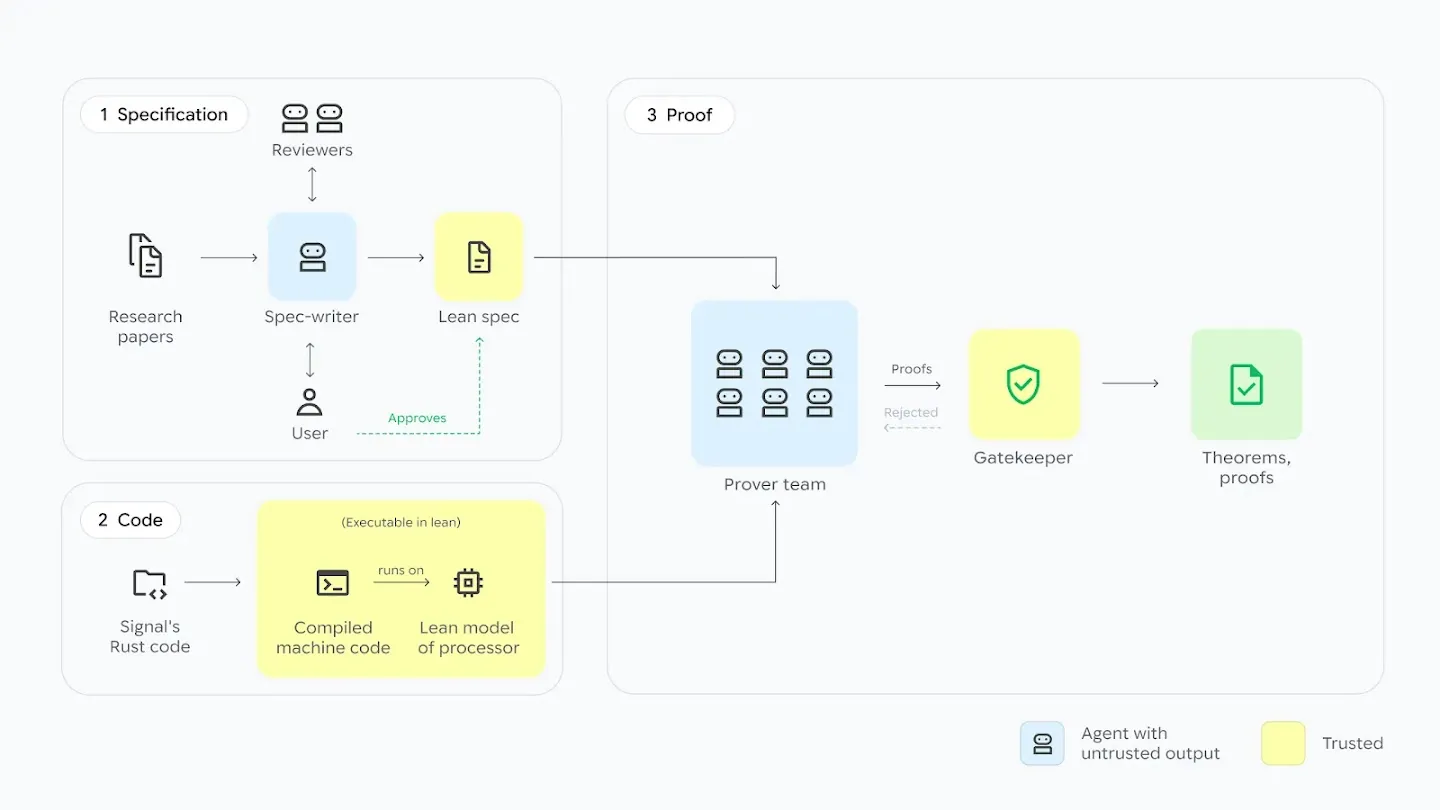
Workflow diagram: people review a spec-writer agent that turns papers into a Lean spec; Signal code compiled to machine code runs on a Lean processor model; prover agents send proofs to a trusted gatekeeper.
Image: Google DeepMind
The problem
Mathematically proving that real compiled software does what its security goals say has needed expert teams working for years, so it is rarely done.
The idea
Split the work by trust. Human experts write and review the specification; agents running on Gemini Carbon write the proofs in the Lean proof language; Lean checks every proof, and a trusted gatekeeper accepts only what passes.
The result
Over six million lines of Lean in four weeks, with about 1% of the code flagged for a human look. When two old, fixed bugs were put back into a copy, the system produced machine-checked proofs that the buggy versions were insecure (DeepMind's figures).
Use it
Borrow the shape for critical code: you write the spec (tests, invariants), the agent does the work, and an independent checker you trust decides. The verification artifacts are public; the framework itself is not stated to be released.

For youSave-game and economy logic are where a spec-plus-checker loop pays off; property tests are the light version.

More like this Less like this

  1. Idea
  2. Prototype
  3. Code released
  4. Shipping

ReadDeepMind blogVerification artifacts

Software and AI PreprintarXiv preprint

Declare the change first, then check it: same fix rate for a fraction of the tokens

FlowPlan: Reducing the Token Cost of Coding Agents with Abstraction-Guided Planning and VerificationM. Sepidband, J. Shin, S. Wang, et al. (York University)

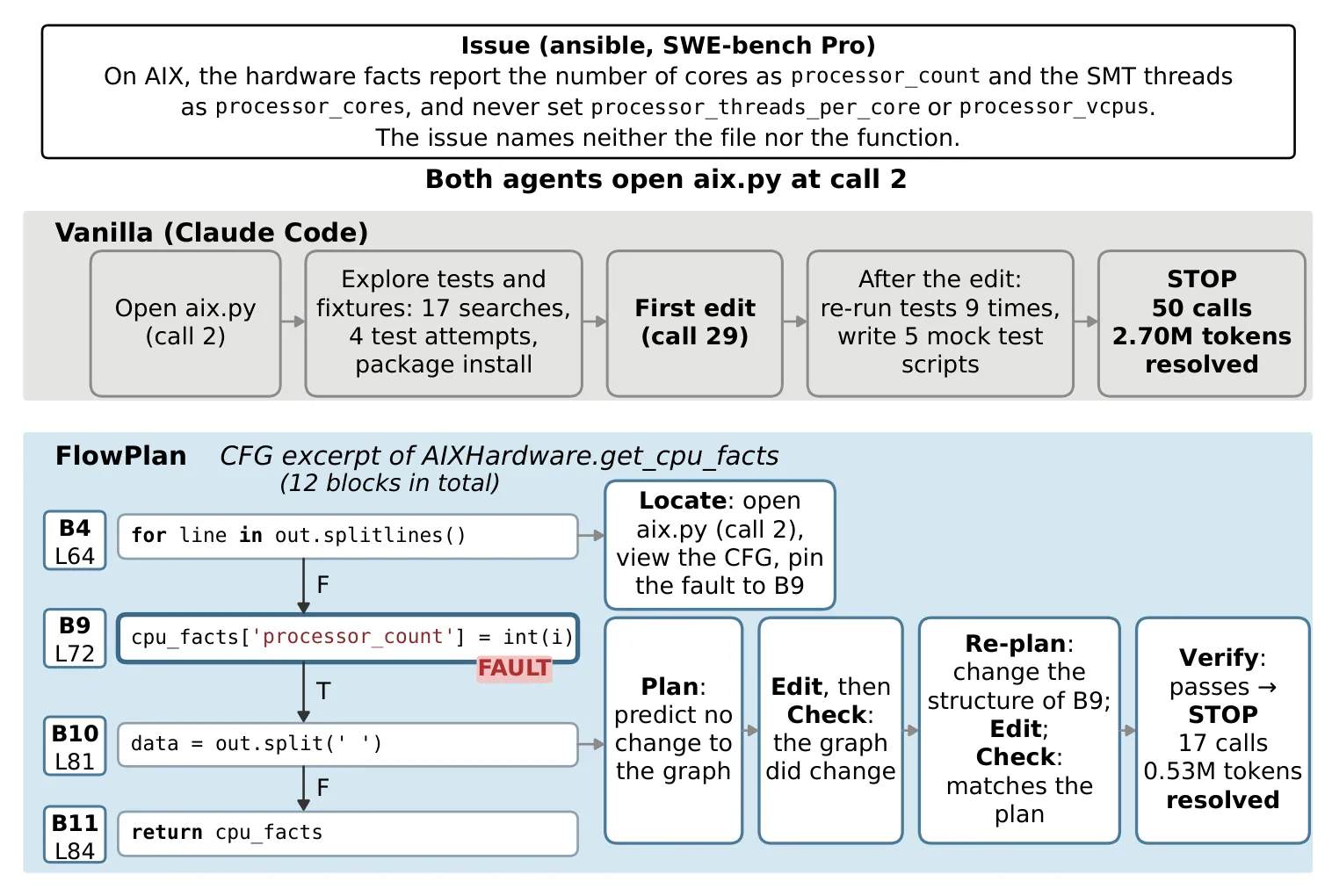
Comparison of two runs on one bug: plain Claude Code takes 50 calls and 2.70M tokens; FlowPlan locates the fault in a control-flow graph, plans, edits, checks and stops after 17 calls and 0.53M tokens.
Image: Sepidband et al., arXiv
The problem
Coding agents spend most of their tokens rereading files and rerunning tests after each edit to convince themselves the fix is right.
The idea
Give Claude Code five MCP tools that show a function's control-flow graph. The agent states its fix as a change to that graph, edits, then checks the rebuilt graph matches the plan, instead of re-testing over and over.
The result
With Haiku 4.5 the agent used 0.32 to 0.47 times the tokens of plain Claude Code on SWE-bench Verified and Pro; with Sonnet 5, 0.72 to 0.76 times. Fix rates were not significantly different. One example went from 50 calls and 2.7M tokens to 17 calls and 0.53M.
Use it
Ask your agent to write the intended change before editing, then compare the diff to it. The repo ships the MCP server and a /flowfix skill to read; savings are smaller on stronger models and the tests are on Python code.

For youA plan-then-diff check is cheap to add to a routine's instructions without adopting the tools.

More like this Less like this

  1. Idea
  2. Prototype
  3. Code released
  4. Shipping

ReadPaper (arXiv)Code

Game dev PreprintarXiv preprint

Neural texture compression learns to stay sharp on surfaces seen at a slant

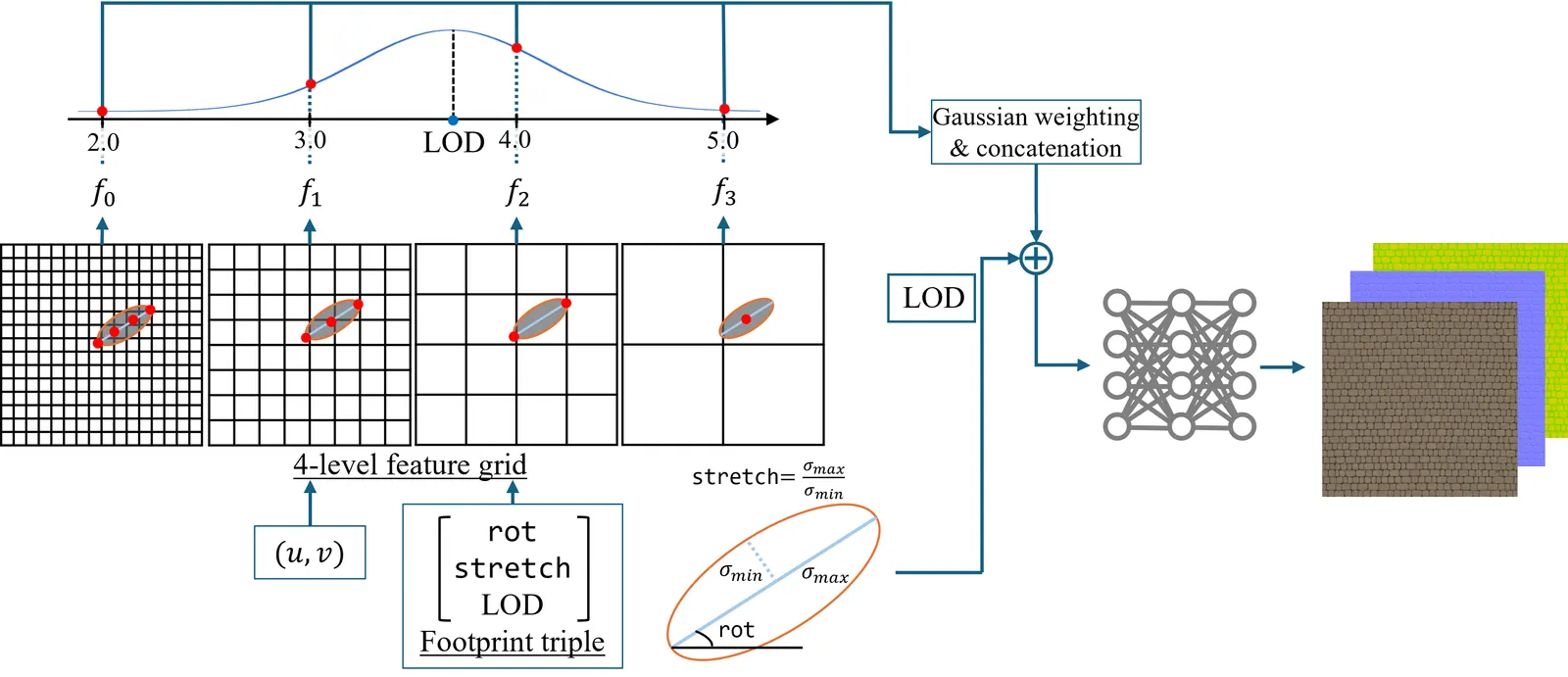
Explicit LOD-Conditioned Anisotropic Filtering for Neural Texture CompressionS. Fujieda, T. Harada (AMD)

Method figure: a four-level feature grid sampled along an elliptical footprint, Gaussian-weighted by detail level, combined with rotation, stretch and level values and decoded by a small network into texture maps.
Image: Fujieda and Harada, arXiv
The problem
Neural texture compression stores materials in a fraction of the memory, but has lacked anisotropic filtering, so floors and walls seen at a steep angle blur or shimmer.
The idea
Feed the small decoder network the same three values a GPU's texture sampler computes (detail level, stretch and angle of the footprint), sample along the stretched axis across four levels, and train against simulated hardware filtering.
The result
A 16.75 MB model replaces 67 MB of BC7 mip chains for three 4K maps. It beats trilinear BC7 by 1.31 to 7.63 dB on all ten test pairs and lands 0.03 to 3.37 dB below anisotropic BC7, a fair price for a quarter of the memory.
Use it
Nothing to ship yet: it runs as a PyTorch emulation with no runtime timings or code. Watch it as a sign neural textures are closing their last quality gap with block compression.

For youRelevant if texture memory becomes the limit for web or mobile builds; no action now.

More like this Less like this

  1. Idea
  2. Prototype
  3. Code released
  4. Shipping

ReadPaper (arXiv)

Also moving

This week on Toa Radar

Read the weekly summary: The week the checks moved outside the agent
Tune mode is on in this browser. Turn it off