A frontier model you can download
Meta published the full weights of one of its biggest AI models, so anyone with enough hardware can run it themselves instead of renting it through an API.
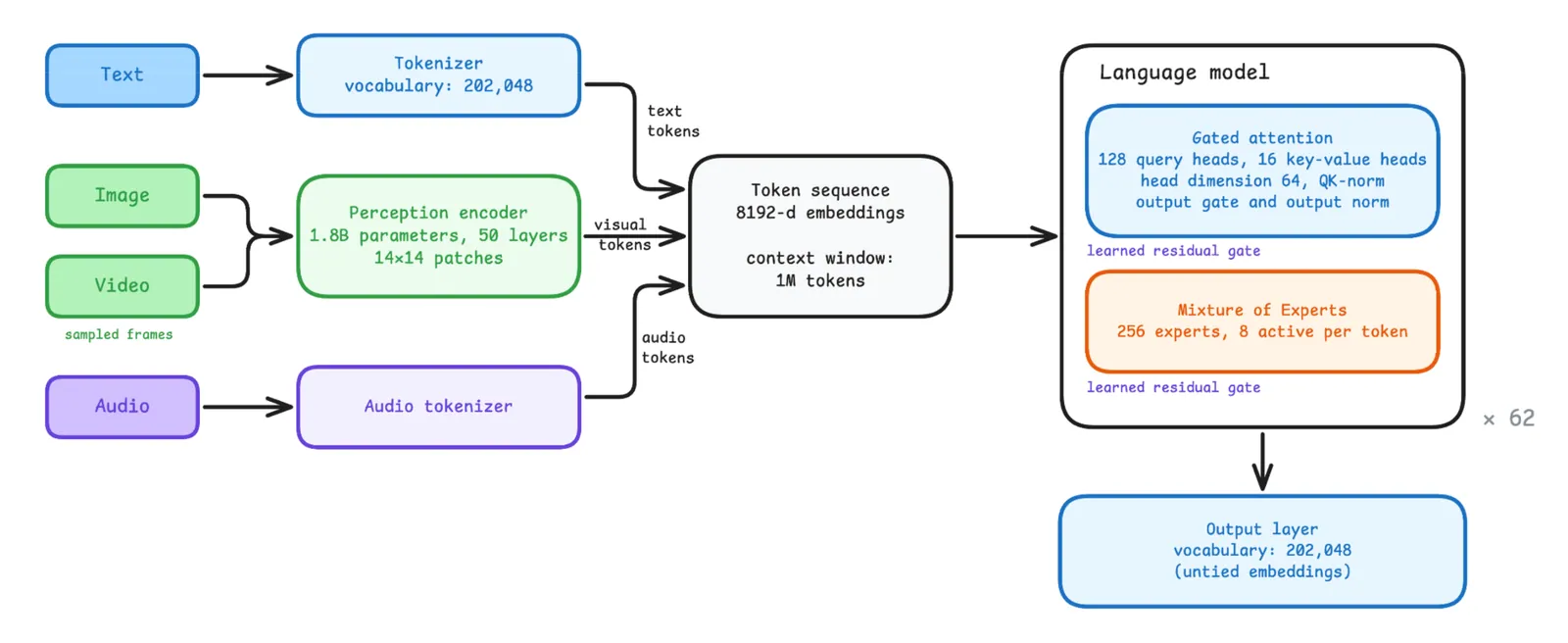
Muse Spark Open reads text, images, audio and video and writes text, with a context window of up to 1M tokens. It is a mixture of experts: about 816B parameters in total, but only about 42B do work on any given token, picked from 256 experts per layer.
"Runs on a Mac" needs a careful read. The full checkpoint is about 1.5 TB and wants 32 H200 GPUs. A 2-bit quantized build ran at 18 tokens a second on an M3 Ultra with 512 GB of memory, using 304 GB for the model. That is a workstation, not a laptop.
Meta ships it under its own model license rather than a standard open source one, so read the terms before building a product on it. Hugging Face lists ready-made builds for llama.cpp and MLX.
42Bparameters active per token, out of about 816B in total
Technical details
Specs from the Hugging Face post: 62 layers, 256 experts per MoE layer with 8 routed per token, a 1.8B parameter perception encoder for images and video, a 202,048 token vocabulary. BF16 in transformers needs 4 nodes of 8 H200 (TP=32); NVFP4 fits a single B200 node, and vLLM's NVFP4 path needs Blackwell GPUs.
Mac numbers on an M3 Ultra with 512 GB: llama.cpp imatrix 2-bit at 18 tokens/s using 304 GB; MLX oQ3e at about 344 GB with roughly 225 tokens/s prefill and 21 tokens/s generation. LoRA fine-tuning took about 2 hours for 500 steps on 8 nodes of 8 H100.
Why it mattersAn open-weight model at this size means private, offline and fine-tuned deployments of frontier-class AI, but the hardware bill decides who can use it. For most teams the practical route is still a hosted endpoint.
For youNot a replacement for Claude Code in your daily loop. Worth a test as a hosted endpoint for Polyglyph-style batch jobs where data must stay on hardware you control; check the license's commercial terms first.
- weights
- The numbers a model learned during training; having them means you can run the model yourself.
- mixture of experts
- A model split into many smaller sub-networks, where only a few are used for each word, so it runs faster than its size suggests.
- parameters
- The individual learned numbers inside a model; more usually means more capable and more expensive to run.
- context window
- How much text, images and other input a model can consider at once.
- quantized
- Stored with fewer bits per number, which shrinks the model at some cost in accuracy.
- checkpoint
- A saved copy of a model's weights, ready to load and run.
Sources Hugging Face: Welcome Muse Spark OpenMeta ResearchTechCrunch